In civil engineering and construction materials testing, Quality Assurance (QA) and Quality Control (QC) are the backbone of project accountability. This data is the record of what was built, how it was tested, and whether it met the project specifications. When that data lives partly in someone’s head, on their laptop, or in a storage system only they understand, every departure turns into a data integrity event.
So how do you ensure data is being properly stored and organized, and if your laboratory management information system (LIMS) follows the required standards even after an inspector leaves?
In this blog, we’ll take a look at what happens when data is not properly kept and how a LIMS protects you from data loss and helps you stay audit-ready.
The Problem
Here’s what typically happens in organizations without a robust LIMS:
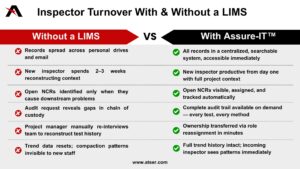
Orphaned test records: Inspection reports and test logs spread across personal drives, email threads, and ad-hoc spreadsheets with no clear owner.
Lost chain of custody: No traceable record of who sampled what, when, under which standard, making audit defense nearly impossible.
Invisible non-conformances: Unresolved NCRs that the departing inspector was tracking informally, now falling through the cracks entirely.
Compliance exposure: ASTM and AASHTO-referenced records that can’t be produced on demand, turning a routine audit into a liability event.
Real World Scenario
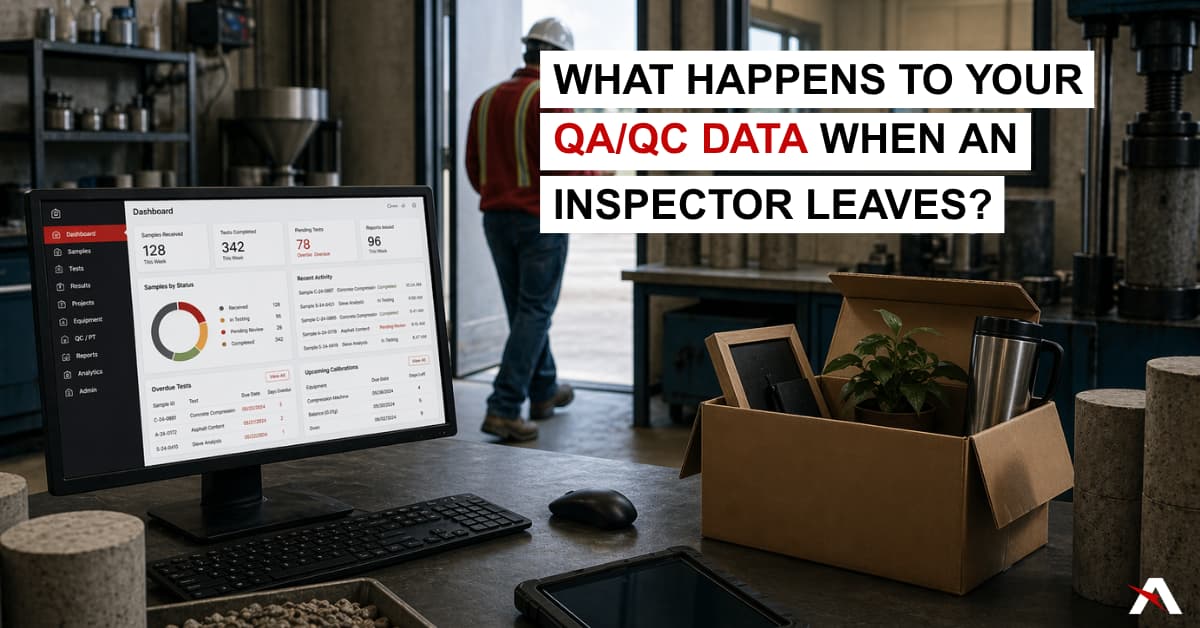
Imagine a DOT project where three independent testing firms share oversight responsibility. An inspector from one firm departs mid-project. Their replacement inherits a stack of paper field reports and a spreadsheet no one else knows how to read. Meanwhile, a concrete pour that occurred six weeks ago “tested by the departed inspector” is now being questioned by the project engineer. Can anyone reconstruct the test record? Who signed it? What equipment was calibrated? Which spec revision was in force?
If the answer involves asking the former employee for their personal files, the organization has a serious vulnerability.
This is especially common in organizations that scaled up quickly on large infrastructure programs, or that still rely on spreadsheets and scanned PDFs as their primary QA/QC record-keeping method. The individual inspector becomes the connective tissue that holds it all together, and when they leave, the gaps become visible all at once.

Turnover is not the only Issue
The risks described above aren’t limited to resignations. They apply equally to:
- Medical leave: An inspector is unexpectedly out for six weeks. Their work orders need coverage by next week. How quickly can you bring someone up to speed?
- Project handoffs: A major infrastructure program transitions from design phase to construction phase, bringing in a new testing firm. How seamlessly does the QA/QC record transfer?
- Multi-firm projects: State highway agencies, transit authorities, and large municipal programs often involve multiple firms with overlapping QA/QC responsibilities. Without a common data platform, every boundary between firms is a data integrity risk.
- Litigation and claims: Construction disputes frequently hinge on historical QA/QC documentation. An organization that can produce a complete, tamper-evident, timestamped record has a fundamentally different legal exposure than one that cannot.
QA/QC Data Without System Protection
Without a centralized database that stores and documents a lab’s construction data, there cannot be efficient QA/QC done. Most data is stored in disconnected workflows and manually updated. There is no real visibility to ensure that your lab is on track.
The problem doesn’t lie in the way information is created or structured, but in how data is handed over and handled. The continuity of construction project information should be treated as part of the design requirement and not just an administrative task. Instead of treating the handover of data as an obligatory target, the focus should be on proving compliance. Without an intentional structure established early on and throughout project delivery, data versions are scattered across incompatible platforms and version conflicts.
How LIMS Protects You
A LIMS is defined as software designed to manage laboratory data, workflows, and quality processes according to ScienceDirect. It supports activities such as sample scheduling, electronic data capture, data tracking, and quality control management.
Built-in documentation creates a reliable record throughout every stage of project completion. The system preserves historical data, current configurations, and past installations in a centralized location.
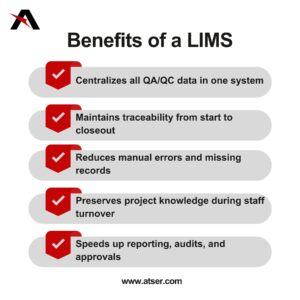
This continuity helps stakeholders understand design intent, operational changes, and field decisions made under tight deadlines. Teams can quickly access updated system diagrams, equipment records, and project history without relying on individual inspectors. Maintaining traceability from project kickoff through closeout keeps QA/QC data accurate, connected, and audit-ready.
The ASTM and AASHTO compliance dimension
Civil engineering labs are increasingly required to demonstrate that their testing processes are not just technically correct, but fully documented and reproducible. Accreditation under programs like AASHTO’s AAP and/or CCRL, or lab-specific ISO 17025 certification demands traceability records that tie every test result back to the method, the equipment, and the qualified personnel who performed it.
When those records live in a LIMS, producing them is a report export. When they live in a person’s files, producing them is a project in itself, and in a time-sensitive compliance situation, that’s a difference that matters.
Benefits of LIMS Beyond Data Protection
Data protection is the headline, but organizations that implement LIMS well quickly discover that the return on investment extends well past keeping records safe when someone leaves.
Fewer rework cycles. Real-time flagging against spec thresholds means problems surface the same day, not weeks later when a deficiency is already paved over. Catching an issue one phase earlier routinely saves multiples of the LIMS investment.
On-demand client confidence: When a DOT or transit authority asks for a quality status update, the answer should take minutes. A centralized LIMS produces dashboards, test completion rates, and NCR status on demand, replacing “let me get back to you” with instant transparency.
Less admin for technical staff: ASTM and AASHTO-compliant reports are generated as a byproduct of normal data entry. Senior engineers and inspectors focus on judgment and decisions, not formatting PDFs.
Scalability without overhead: A centralized LIMS serves ten projects as naturally as two. Standardized workflows and a single source of truth mean growth doesn’t degrade data quality.
Data as a strategic asset: Years of structured testing data become a searchable and actionable mix design performance, compaction failure rates by soil type, and strength trends by supplier. Patterns that once lived in one person’s memory are now available to the whole team.
A procurement differentiator: For firms competing on public agency contracts, demonstrable QA/QC capability signals maturity and reduces perceived risk. In a competitive shortlist that carries real weight.
How ATSER’s LIMS Changes The Game
A Laboratory Information Management System, specifically one built for civil engineering and construction materials testing, like ATSER’s Assure-IT™ platform, is designed around one core principle: the data belongs to the project, not the person.
Here’s what that looks like in practice:
- Centralized, Cloud Data From Day 1: Every sample logged, every test performed, and every inspection recorded flows directly into a centralized quality database, not a local drive, not a personal inbox. From the moment field data is captured, it exists in a system that no single team departure can compromise. ATSER’s quality data flows automatically from field inspectors, testing technicians, and remote laboratories into one unified record.
- Complete Chain of Custody: Every action in Assure-IT™ gets logged with a timestamp and a user. Who collected a sample, who performed a test, and whether ASTM or AASHTO standards were followed. Which equipment was used, and whether it was within calibration.
- Role-based Access: When an inspector is onboarded in ATSER’s system, they work within a defined role structure. Their data contributions are tagged, their pending items are visible, and their work queue can be reassigned without losing context. When they leave, an administrator transfers ownership in minutes, not days of manual archaeology.
- Offline Field Data Capture: With Assure-IT™, field data does not wait for connectivity. By using ATSER’s mobile app Field-IT™, inspectors can’t “forget” to log results because there’s no manual transfer step. Even if there is no internet connection, the data that enters the system syncs automatically when connection is restored.