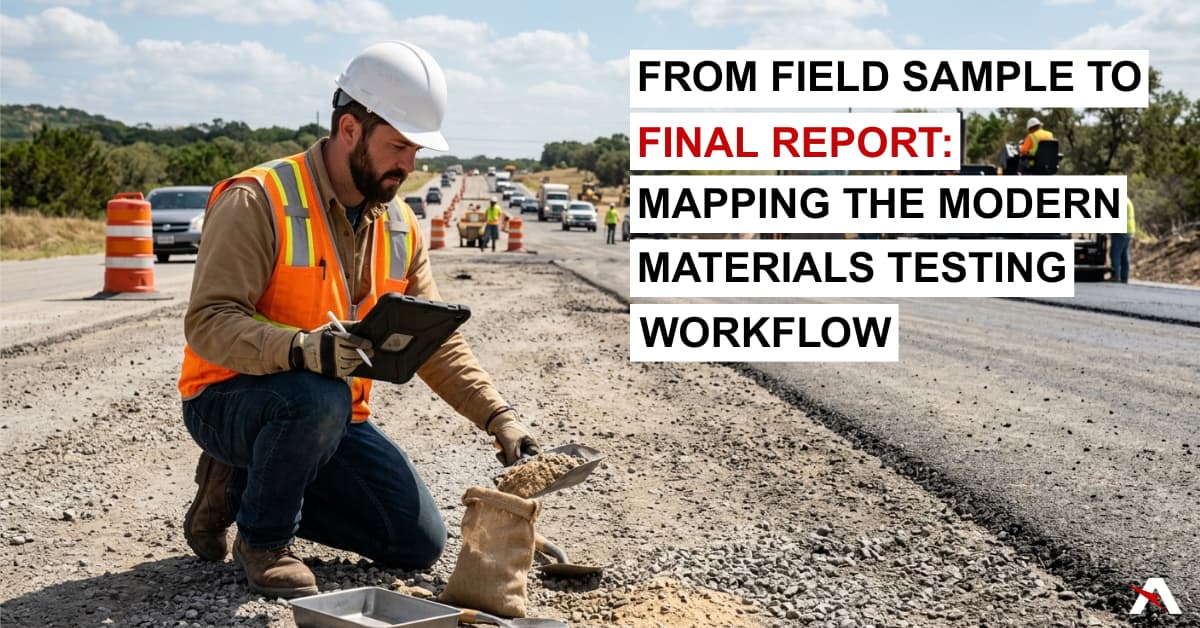
Ever wonder how companies in the AEC industry keep track of a field sample all the way to a final report?
With hundreds of active projects and tight deadlines, disconnected workflows often create delays, errors, and communication gaps. The Project Management Institute found that poor communication contributes to project failure nearly a third of the time.
In construction materials testing, where a missed test or a documentation gap can trigger non-conformances, stop-work orders, or a very uncomfortable call with the owner’s rep, the margin for error is thin.
So, let’s walk through what this process typically looks like, from the moment a project kicks off to the moment a final report lands in the right hands.
How It Begins
Before the first technician ever gets dispatched, someone from the team has to sit down with the contract documents and figure out exactly what’s required. That means reviewing the geotechnical report and the testing frequencies specified in the project spec. What gets tested? How often? To which testing standards? Who gets the reports, and how fast?
Despite how advanced technology is in 2026, many firms still do this part in spreadsheets. Some do it in their heads. Neither scales particularly well once you’re juggling a dozen active projects at once.
Dispatch is Where Disaster Kicks In
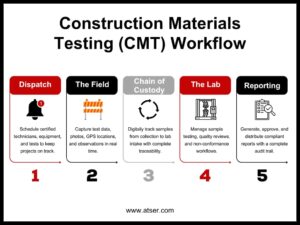
Dispatching is where most project managers lose control. They’ve got technicians who need to be in specific places at specific times. Project Managers need to know who has the right certifications for each job (ACI, ICC, NICET, or whatever standard the spec requires), who has the right equipment, and who can realistically get there on time.
At some firms, this coordination happens through a mix of phone calls, text threads, and a shared calendar online, or worse, a spreadsheet. It works, until it doesn’t. And when it doesn’t, it could mean a missed test is a materials pour that went ahead without documentation. A report filled out from memory three hours later.
What Happens On The Field?
When a technician gets on-site, the first thing they have to do is confirm that the work is actually ready. This sounds obvious, but it matters. Concrete testing has to happen at the point of discharge, within a specific time window. If the pour has already started, or the load has been sitting too long in the heat, the test can’t happen, and no amount of creative documentation fixes that.
From there, everything follows ASTM procedure (in the U.S.). Cylinders cast and labeled. Batch ticket data recorded. Environmental conditions noted. Soil tests logged with equipment serial numbers and calibration dates. Every data point is part of a chain that either confirms the work meets spec or raises a flag that something needs attention.
The problem with paper forms is that the chain breaks the moment the form sits in the truck. The data that needs to be in the system tonight might not get there until tomorrow morning, or later, transcribed by hand, with all the eligibility errors that come with that. Mobile field apps that capture data in real time, with GPS and timestamps built in, close that gap in a way that paper simply can’t.
Chain of Custody
Physical specimens, i.e., concrete cylinders or soil samples, have to get from the field to the lab with a clear, documented record of who handled them, when, and under what conditions. That’s not a formality. It’s a compliance requirement, and it’s one that still involves paper in many labs.
The gap between “data collected in the field” and “data available in the system” can stretch to hours or even days in a manual workflow. When that gap exists, things get lost, mislabeled, or simply forgotten. A connected platform eliminates that gap by tying field collection directly to lab intake, so by the time a specimen arrives at the lab, the project engineer already knows it’s coming.
The Lab Stage
Specimens get cured, broken at the required ages, and reviewed against the spec minimums. Most of the time, everything passes, and the report goes out. But when something fails, and on large projects, the chances are that it will, the response has to be fast and well-documented.
That means notifying the General Contractor (GC) and owner’s rep promptly, issuing a non-conformance report (NCR), and tracking corrective action all the way to resolution. An NCR that gets handled properly is a manageable situation. One that gets buried and resurfaces at closeout is a much worse problem for everyone involved.
Reporting Stage
All field work and lab testing ultimately feed into reports that go to the GC, the owner, and sometimes a third-party reviewer or agency. Turnaround expectations vary but fast-track projects often want results the same day or the next day. And the format usually has to conform to specific agency or DOT requirements.
Version control matters more here than most people think. When a report gets revised because a result was reconsidered, a number was wrong, or a test had to be re-run, there has to be a clear record of what changed and when. Without that, you’re exposed the moment someone asks to see the audit trail.
Electronic review and approval make the distribution part faster and cleaner. Reports go to the right people automatically once they’re signed off, instead of sitting in someone’s outbox waiting to be forwarded.
Project managers can review and electronically sign reports with just a few clicks. Once approved, the LIMS automatically generates final reports for clients and project teams.
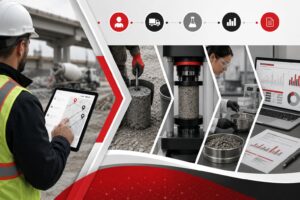
What A Modern Materials Testing Workflow Looks Like
It starts with getting the project set up properly before anyone goes anywhere. The testing matrix, i.e. sample types, testing frequencies, applicable standards, report recipients, and turnaround requirements, needs to live somewhere that the whole team can see and trust. Not in someone’s email. Not in a spreadsheet that only one person keeps updated. In a single system that’s accessible from the office and the field, from day one to closeout.
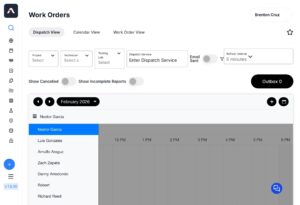
When it’s time to dispatch, project managers need a live picture of what’s happening, who’s certified for what, who has the right equipment, and who’s schedule is available. Dispatch notifications need to go out with specific instructions attached, not a vague text asking someone to “head over to the site on MLK.” If something changes in the field, that update needs to flow back through the same system, automatically, so everyone sees it without a round of phone calls.
In the field, data needs to be entered into the system the moment it’s collected, not when the technician gets back to the office. That means mobile collection that works with or without cell service, with GPS and timestamps captured automatically. Chain of custody documentation needs to happen in real time too, so by the time a specimen arrives at the lab, the intake process is already underway rather than starting from scratch.
On the lab side, the goal is to eliminate re-entry entirely. Results should go directly into the same system where the samples were logged, already tied to the right project, already connected to the spec requirements they need to be evaluated against. Non-conformances should get flagged automatically as they occur, not discovered later when someone is assembling the closeout package.
Reporting needs version control, electronic approvals, and automatic distribution so there’s always a clear record of what changed and when, reports don’t sit in anyone’s outbox waiting to be forwarded, and the audit trail is intact without anyone having to maintain it manually.
And at closeout, pulling the final summary should take minutes, not days. If the workflow was connected from the start, everything is already there, organized, traceable, and ready to hand off.
That’s the standard a modern LIMS should be hitting. And it’s exactly what ATSER’s Assure-IT™ 2.0 was built to deliver. From the initial project setup and live dispatch dashboards to mobile field collection, automated lab workflows, and version-controlled reporting, it’s one connected system that keeps every handoff clean and every record intact, from the first sample to the final signature.
If you’re ready to see what that looks like applied to your projects, schedule a demo with our team. We’ll walk you through the workflow end-to-end and show you exactly where it fits into the way you already operate.
Other Assure-IT™ 2.0 Benefits
Organized Sample Management From The Start
Assure-IT™ 2.0 streamlines sample management with dynamic indexing and organized retrieval capabilities.
Teams can quickly create, organize, and retrieve samples throughout the project lifecycle. The OneSearch functionality allows searching for documents with keywords inside the system.
Flexible Test Configuration & Intelligent Reporting
Testing workflows can be managed directly within Assure-IT™’s Test Studio. Laboratories can customize test templates and modify workflows to meet agency or DOT requirements.
AI-assisted automation helps populate testing data using historical project information and previously completed tests.
This reduces repetitive manual entry while improving reporting consistency across projects.
Real-Time Communication Between Office & Field Teams
Effective QA/QC depends on fast communication between dispatchers, technicians, and project managers.
Assure-IT™ delivers automated dispatch notifications through text, email, and in-app notifications. Technicians stay informed about assignments, updates, and schedule changes in real time.