
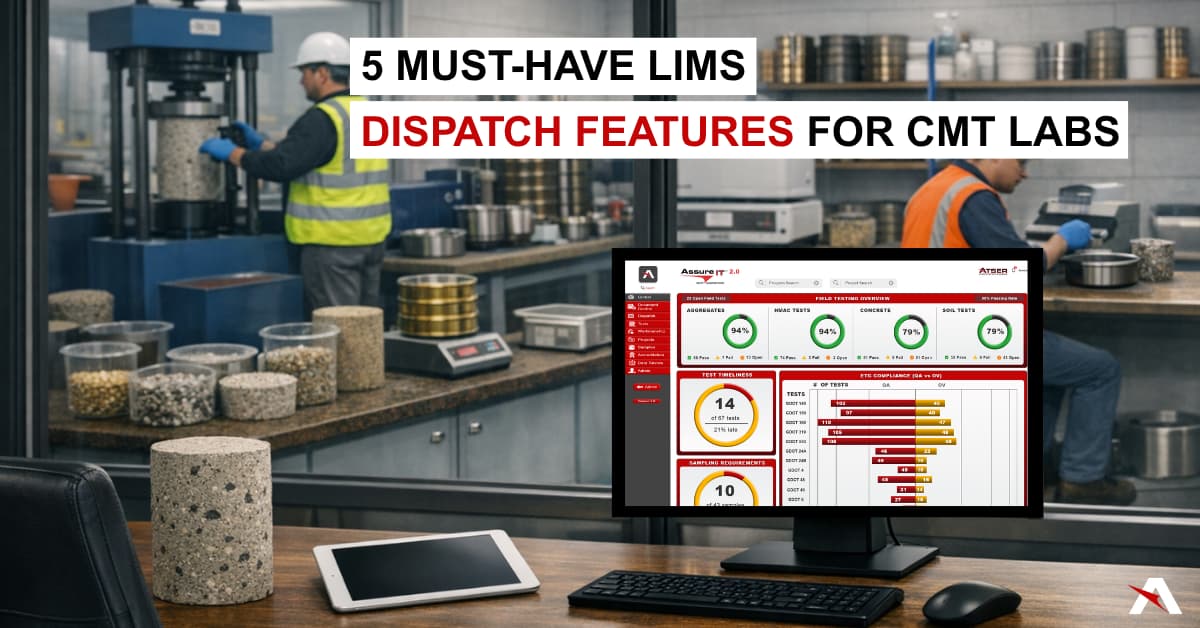
For decades, project managers in materials testing have relied on disconnected workflows, paper logs, phone calls, wall charts, and email chains to coordinate field technicians and lab operations. The result? Chronic miscommunication, scheduling bottlenecks, and costly inefficiencies that compound across every project phase.
The numbers tell a story. According to the U.S. Bureau of Labor Statistics’ Construction Labor Productivity report, productivity in highway, street, and bridge construction declined every year from 2021 to 2024, showing an imbalance between output and hours worked.
The solution isn’t working harder; it’s working smarter. A modern Laboratory Information Management System (LIMS) with a robust dispatch module can eliminate the friction that’s quietly draining your team’s productivity. This blog examines the challenges of manual dispatching, the benefits of digital workflows, and five essential LIMS features for materials testing labs.
The Challenges of Manual Dispatching
Before diving into the features, it’s worth understanding exactly what’s at stake. Traditional dispatching means sample testing requests arrive through informal channels, such as texts, calls, or emails, and approvals have to be chased down separately. Supervisors manually assign tasks through weekly calendars. Dispatchers spend hours planning routes by phone. Technicians record field data on paper and report findings by fax or in person.
Every link in that chain is a potential point of failure. Sudden schedule changes require individual notifications. Miscommunications lead to errors, rework, and callbacks. By the time data gets from the field to the lab, critical time has already been lost.
Digital dispatch changes that equation entirely, but only when the right features are in place.
Digital Tools Transforming Lab Dispatch
With a LMIS, project managers or dispatchers receive sample requests and assign certified technicians efficiently. The system checks technician availability, then notifies them with assignment details. Technicians are dispatched to exact locations and can fill out digital forms while collecting samples. Once complete, tests are sent electronically to the dispatcher or project manager for approval.
Feature 1: Real-Time Field-to-Lab Visibility
A LIMS dispatch module without live visibility is little more than a digital calendar. True field-to-lab visibility means stakeholders can see exactly what is happening, where technicians are, what tests are in progress, and what test results are pending, right at the same time that data is captured in the field.
According to QuickBase, 61% of companies still rely on disconnected software platforms, and fewer than 40% have automated workflows in key business areas. That disconnect creates blind spots that slow down decision-making.
A modern LIMS closes that gap. As technicians capture data through mobile devices on-site, dispatchers and project managers receive updates in real time no waiting for field returns, no chasing down status reports.
Feature 2: Smarter Scheduling and Optimized Dispatch
The 2023 FMI Labor Productivity Study reported $30–40 billion lost annually due to poor construction productivity. Digital dispatch eliminates coordination gaps and keeps technician certification status current.
Smart dispatch goes beyond assigning the next available technician. A capable LIMS dispatch module should automatically verify technician certification status, check availability, factor in location, and log environmental conditions like time and weather using GIS tracking, all without manual input.

Feature 3: Electronic Signatures & Approvals
Paper-based approval processes are a bottleneck hiding in plain sight. When technicians complete field tests, the traditional path to approval involves printing, signing, scanning, and emailing, a chain that can stretch a same-day result into a multi-day delay.
A modern LIMS dispatch module eliminates that entirely. With built-in electronic signature functionality, technicians can submit completed tests to project managers for approval with a single tap. Managers review and sign off within the same platform, no printing, no scanning, no back-and-forth.
Faster approvals don’t just save time. They accelerate report delivery to clients, reduce administrative overhead, and contribute to more sustainable, paperless operations.
Feature 4: Seamless Report Management
A LIMS should become the single source of truth for all tests executed. That means logging samples efficiently, executing tests, generating and archiving reports in one platform.
Whether a project manager needs test results from yesterday, last week, month or year, test report retrieval should be effortless. A well-designed LIMS allows any sample to be indexed and pulled up with a single search query.
Feature 5: Data-Driven Performance Tracking
A dispatch module that only manages schedules is leaving value on the table. The most capable LIMS platforms use the data they collect to generate performance insights that help labs continuously improve.
An auto-updating dashboard should give project leaders a clear view of technician activity, test outcomes, pass/fail rates, and productivity trends, all drawn from both historical and live data. This kind of visibility enables proactive decision-making: identifying recurring failures early, flagging certification gaps before they become compliance issues, and tracking team performance across projects with objective metrics.
How ATSER’s Assure-IT™ Delivers All Five
ATSER’s LMIS solution, Assure-IT™ “Quality Assurance System”, is purpose-built to address every one of these demands in a single online platform.
End-to-End Visibility: Assure-IT™ provides real-time visibility from sample tracking through report generation, backed by live trend analysis and a reliable centralized database. Project managers always know where their technicians are and where every test stands.
Smart Dispatch at Scale: Assure-IT™’s centralized dispatch workflow eliminates paper-based processes and outdated scheduling tools, streamlining coordination across every project phase. Certification tracking, GIS logging, and mobile-first assignment delivery keep technicians efficient in the field.
Faster Approvals: Assure-IT™’s mobile app enables technicians to capture field results instantly and submit them for electronic signature approval accelerating the entire approval-to-delivery cycle and significantly improving operational efficiency.
Unified Report Management: From QA dashboards to NCR tracking, all reporting lives in one platform. Teams collaborate through an integrated notes overlay, and unlimited cloud storage means no project history is ever out of reach.
Performance Insights: Assure-IT™’s dashboard continuously updates with insights derived from ongoing tests, giving project leaders the data-driven metrics they need to monitor performance, identify trends, and drive continuous improvement.
References: