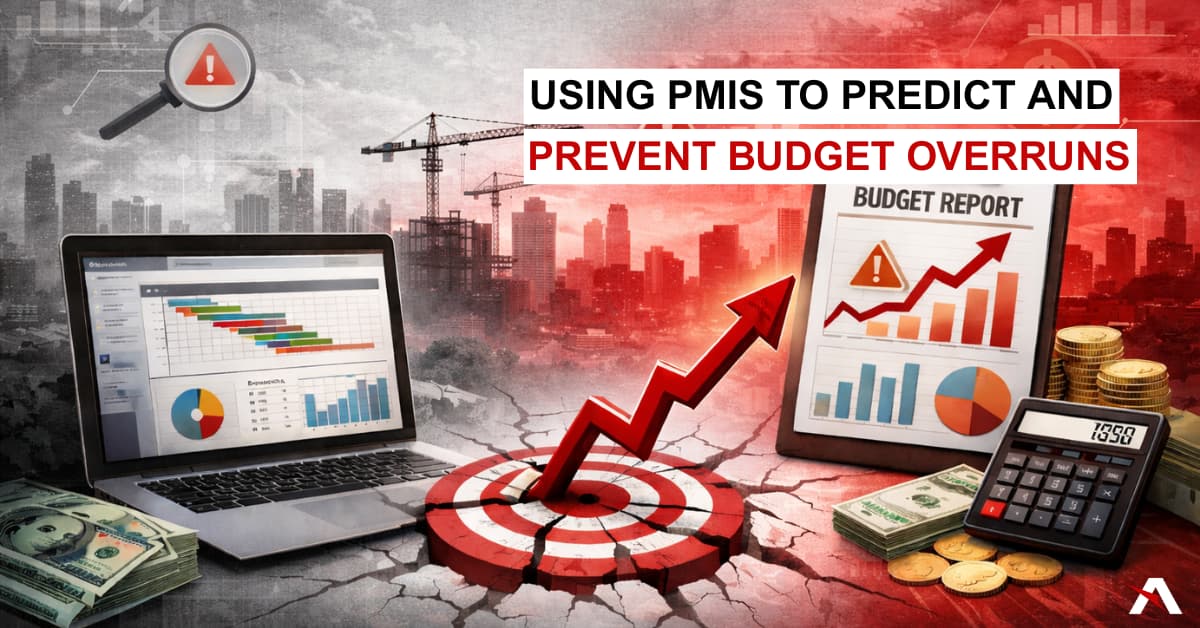
If you’ve managed projects for any length of time, you know budget overruns are one of the most persistent, painful, and costly problems in project management. And yet, most of them are entirely preventable.
The difference between teams that consistently deliver on budget and those that don’t often comes down to one thing: how early they see problems coming. That’s where a Project Management Information System (PMIS) changes everything.
In this blog, we analyze the key drivers behind construction cost overruns, examine the financial and operational challenges capital projects face, and present practical strategies to strengthen forecasting, risk management, and budget control.
What Is a PMIS?
According to the Project Management Institute (PMI), a Project Management Information System (PMIS) is a centralized, typically digital, tool or software used to collect, organize, and distribute project data. It supports all project phases from initiation to closing, aiding in scheduling, budgeting, and performance tracking.
What is a Cost Overrun?
A cost overrun occurs when actual project expenses exceed the approved budget. Despite ongoing efforts to improve forecasting and controls, this challenge remains widespread across the construction industry. A 2016 report by McKinsey & Company found that nearly 80 percent of large-scale construction projects exceed their original budgets. Several common factors contribute to this outcome.
Why Do Budget Overruns Happen?
Before we talk about how PMIS helps, it’s worth understanding the root causes of budget overruns, because most of them are rooted in information problems, not in project execution constraints.
Inaccurate initial estimates: projects often begin with optimistic assumptions about labor productivity, material costs, and timeline. When reality diverges, the budget absorbs the shock.
Resource misallocation: the right people aren’t available when needed, leading to delays that compound costs, or expensive resources get used for tasks that didn’t require them.
Siloed information: Finance is working from one spreadsheet. Project managers are working on another. Field teams are tracking actuals in a different system entirely. By the time anyone reconciles the data, it’s too late to course correct.
Scope creep without cost adjustment: new work gets added informally, but the budget baseline never changes. Over time, you’re doing 20% more work on the same budget.
Reactive rather than proactive management: most budget tracking looks backward; it tells you what you’ve already spent. Without forward-looking indicators, teams only discover overruns after they’ve happened.
A well-implemented PMIS addresses every single one of these failure points.

How PMIS Predicts Budget Overruns
This is where the real power lies. Here are the core mechanisms a PMIS uses to give you early warning signals.
Earned Value Management (EVM)
EVM is one of the most powerful budget forecasting techniques available, and a robust PMIS makes it automatic. EVM integrates three data points: planned value (what you planned to spend by now), earned value (what you’ve actually accomplished), and actual cost (what you’ve actually spent) to generate forward-looking metrics.
The two most critical are: Cost Performance Index (CPI) and Estimate at Completion (EAC).
Without a PMIS, calculating EVM manually is tedious and error prone. With one, it runs in the background continuously.
Real-Time Cost Tracking and Variance Analysis
Traditional budget tracking works in cycles, with weekly reports and monthly reconciliations. By the time a variance is identified, the cause may be weeks old and the damage already done.
A PMIS pulls actual costs in near real-time, often integrating directly with your accounting systems, procurement platforms, and payroll. This means:
- Labor costs are visible the moment timesheets are submitted, not weeks later when invoices are processed.
- Purchase orders and change orders are linked directly to budget line items.
- Variances are flagged automatically, with alerts sent to the right people as soon as a threshold is crossed.
The faster you see a variance, the more options you have to respond.
Schedule Integration and the Cost of Delay
Here’s something many project managers underestimate: schedule slippage is a budget problem. Every week, a project runs long, costs money, requires extended labor, prolonged equipment rentals, escalating subcontractor costs, and delayed revenue. A PMIS that integrates schedule and cost data can model the financial impact of delays in real time.
If a critical path task slips two weeks, your PMIS can immediately calculate what that delay will cost in additional resource expenditure and forecast its impact on the project’s cost baseline. This connection between schedule performance and cost performance is invisible when you’re managing them in separate systems.

Resource Loading and Forecasting
One of the subtler causes of budget overruns is resource underutilization or conflicts that don’t show up until they become emergencies. A PMIS maintains a resource-loaded schedule, which means you can see:
- Which resources are over-allocated (leading to overtime costs or quality problems)
- Which phases of the project will require resource surges (so you can plan ahead rather than scramble)
- What happens to your budget if a key resource becomes unavailable
By modeling resource scenarios proactively, you can identify cost risks before they become cost realities.
How PMIS Prevents Budget Overruns
Prediction is only half the equation. Here’s how a PMIS helps you act on what you’re seeing.
Automated Alerts and Escalation Paths
A PMIS doesn’t just surface data; it can be configured to alert the right people at the right time. When a cost variance exceeds 5%, the project manager gets a notification. When it exceeds 10%, the sponsor is looped in. When a purchase order is about to exceed its approval threshold, it automatically routes to the appropriate authority. This systematic escalation prevents the “we knew but didn’t act” failure mode that derails so many projects.
Change Control Integration
Scope creep kills budgets silently. A PMIS with integrated change control ensures that every change request is formally evaluated for cost and schedule impact before it’s approved. The system maintains a full audit trail of all changes, making it impossible for the scope to grow without a corresponding budget conversation.
Standardized Reporting Across the Portfolio
One of the most underappreciated benefits of a PMIS emerges at the portfolio level. When every project is reporting using the same data structures and metrics, leadership can compare performance across projects, identify systemic issues (are all our infrastructure projects running over budget, or just this one?), and make informed resource allocation decisions.

Best Practices To Prevent Budget Overruns
Strengthen Cost Estimation from the Start
Accurate cost estimation establishes a reliable financial foundation. To achieve this, experienced estimators should develop comprehensive and data-driven projections. With detailed breakdowns of equipment, labor, financing, and contingency costs, stakeholders gain clearer visibility into potential financial risks.
Build Contingency and Risk Management Plans
Unforeseen conditions require structured contingency planning. Typically, allocating 5 to 10 percent of the total budget mitigates unexpected cost impacts. Alongside that, strong governance and daily budget monitoring enhance financial stability. As a result, coordinated oversight reduces miscommunication and specification gaps.
Optimize Resource Allocation
Strategic resource planning ensures alignment with budget limitations and project objectives. Furthermore, detailed procurement processes identify contractual inconsistencies early. Through these reviews, teams can correct errors before they escalate into costly disputes.
Invest in Skilled Teams
Hiring experienced professionals improves execution accuracy and cost predictability. Moreover, ongoing training enhances workforce capability and operational efficiency. Consequently, projects experience fewer delays and less rework.

How ATSER Transforms Cost Management From Projects To Programs
Through a fully integrated software solution that includes Construct-IT™, Track-IT™, and Assure-IT™, ATSER embeds financial control, schedule, and documentation governance directly into day-to-day project management.
Here Is How ATSER Stands Apart:
Enterprise Program Control with Manage-IT™ 2.0
Manage-IT™ 2.0 serves as the centralized PMIS command center for any capital improvement program. The system aligns workflows, approvals, documentation, and stakeholder collaboration within a structured governance framework, ensuring transparency, traceability, and real-time executive insight across every phase of the project lifecycle.
Financial & Schedule Integrity with Construct-IT™
Strengthen cost control and schedule performance with a comprehensive construction management solution. Construct-IT™ provides detailed tracking of budgets, timelines, quality benchmarks, and administrative records, empowering teams to proactively mitigate risk, maintain compliance, and deliver projects on time and within budget.
Centralized Document Governance with Track-IT™
Eliminate disconnected file systems and manual document handling. Track-IT™ creates a secure, web-based repository with configurable folder structures and automated record organization, giving authorized stakeholders immediate access to accurate, up-to-date project documentation while improving productivity and accountability.
QA/QC Intelligence with Assure-IT™
Elevate quality management from reactive reporting to proactive performance oversight. Assure-IT™ enables real-time data capture from field inspectors and technicians, seamlessly integrating with laboratories and other ATSER modules. With advanced trend analysis, automated reporting, and audit-ready documentation, organizations gain full visibility into quality metrics, nonconformance tracking, and corrective action management.
Why Top Infrastructure Programs Run on ATSER
🔄 A Partner for the Full Program Lifecycle
⚙️ Configuration That Matches Your Project Execution SOPs
🏆 Trusted Across Multi-Million Multi-Year Complex Programs
🛣️ Current Clients Include Multiple Departments of Transportation (DOT)
🙋♂️ Fast Help Desk & Dedicated Account Success Manager