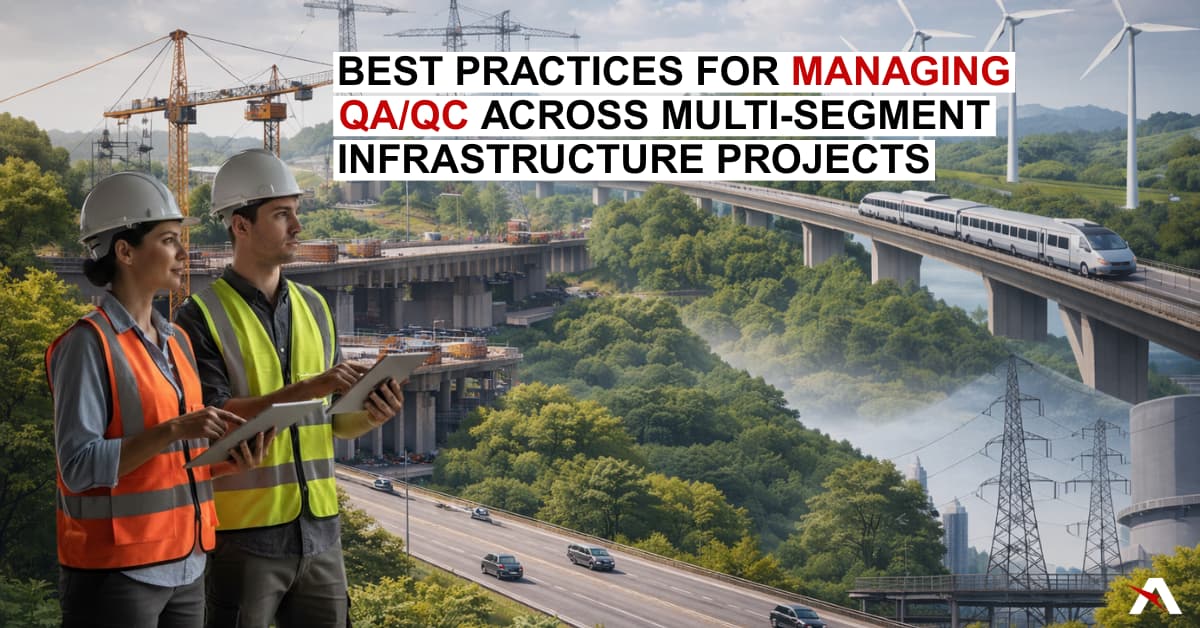
From high-speed rail networks and major port expansions to urban transit systems and utility grids, infrastructure megaprojects now account for a major share of global construction activity. Due to this infrastructure expansion, government agencies are increasingly investing to meet growing societal demands. Construct Connect reports megaprojects drive a 58% annual increase in construction spending and represent 21.1% of nonresidential investment.
Unlike smaller projects where oversight gaps may cause manageable delays, a breakdown in quality assurance (QA) and quality control (QC) on megaprojects can trigger cascading failures with multi-million-dollar consequences. According to industry research from the U.S. National Institute of Standards and Technology, poor quality control costs the U.S. construction sector around 12.7 billion in annual rework, and inefficiencies remain one of the most persistent sources of budget and schedule overruns.
This blog outlines procedures and best practices that deliver results across complex, multi-segment construction projects. It examines proven approaches for maintaining quality standards and enabling effective QA/QC oversight across large infrastructure programs. Together, these practices form scalable quality assurance systems that reduce rework costs and accelerate workflows for organizations investing in megaprojects.
Why QA-QC Fails at Scale
Quality assurance and quality control programs that perform well on small or mid-sized projects typically cannot be applied to large, multi-segment infrastructure programs. As project scale increases, so does organizational complexity. Multiple contractors, consultants, inspectors, and agencies operate simultaneously across distributed locations or program segments, each with their own workflows, tools, and interpretations of quality standards.
This fragmentation creates systemic risk. When QA/QC processes are inconsistent, poorly coordinated, or manually managed, quality issues are no longer isolated; they propagate across work packages and project phases. Design deviations, documentation gaps, and inspection delays can quickly compound, resulting in widespread rework, schedule disruption, NCR’s issuance, and contractual disputes.
At scale, quality failures rarely stem from technical incompetence. They emerge from process breakdowns: unclear ownership, disconnected systems, lack of real-time visibility, and insufficient governance mechanisms. Without a unified quality framework, organizations lose the ability to proactively manage risk and instead rely on reactive inspections that identify problems only after costly impacts have already occurred.
Defining the Roles of Quality Assurance vs. Quality Control
Although often used interchangeably, quality assurance and quality control serve distinct and complementary roles within infrastructure delivery.
Quality assurance focuses on prevention. It encompasses the planned and systematic activities that establish how quality will be achieved, including policies, procedures, standards, training, documentation, and governance structures. QA defines the rules of the system and ensures that project processes are designed to meet regulatory, contractual, and technical requirements.
Quality control, by contrast, focuses on verification. It involves inspections, testing, audits, and field observations used to confirm that materials, workmanship, and construction activities conform to defined standards. QC measures actual performance against expectations and triggers corrective actions when deviations occur.
Together, QA and QC form an integrated quality management function. QA sets the framework; QC validates execution. Alignment between both is essential to ensure that quality is not only specified, but consistently achieved across all project segments.

Building a Program-Level Quality Management System
On large infrastructure programs, quality cannot be managed on a project-by-project basis. It must be governed through a program-level Quality Management System (QMS) that spans all work packages, contractors, and phases of delivery.
A program-level QMS establishes standardized quality policies, processes, roles, and reporting structures across the entire capital program. It defines how inspections are performed, how documentation is managed, how nonconformances are tracked, and how corrective actions are implemented and verified.
This centralized approach ensures consistency, accountability, and traceability. Instead of fragmented quality practices operating in silos, all stakeholders operate within a shared quality framework that enables cross-project visibility, performance benchmarking, and continuous improvement.
At scale, a QMS becomes the primary mechanism through which owners maintain control over quality outcomes, regulatory compliance, and audit readiness.
Embedding QA/QC Into Early Planning and Design
The most effective QA/QC programs begin long before construction starts. Early planning and design phases offer the greatest opportunity to identify and mitigate quality risks at the lowest possible cost.
Pre-design reviews, constructability assessments, and interdisciplinary design validations allow teams to evaluate feasibility, resolve conflicts, and clarify requirements before they materialize in the field. These activities reduce ambiguity, minimize change orders, and prevent systemic defects from propagating across downstream work packages.
Embedding QA/QC into early project phases transforms quality from a reactive control function into a front-end risk mitigation strategy. By addressing quality at the source, organizations significantly reduce the likelihood of rework, claims, and schedule disruptions later in the lifecycle.
Standardizing Quality Across Contractors and Subcontractors
On multi-segment infrastructure programs, quality performance is heavily influenced by the capabilities and practices of delivery partners. Contractors and subcontractors often operate with different internal standards, inspection methods, and documentation processes, introducing variability that undermines program-wide consistency.
Standardization begins with prequalification. Contractors should demonstrate technical competence, relevant experience, certifications, and mature quality management practices as part of the selection process. Beyond qualifications, clear contractual requirements, standardized inspection protocols, and unified documentation frameworks ensure that all parties operate under the same quality expectations.
Consistent coordination, regular quality reviews, and transparent performance reporting reinforce accountability and alignment across delivery teams. Standardization does not eliminate complexity, but it ensures that complexity is managed within a controlled and auditable quality framework.

Leveraging Data and Digital Systems for Real-Time QA/QC
Traditional QA/QC methods rely heavily on manual inspections, paper-based documentation, and disconnected spreadsheets. While sufficient for small projects, these approaches become unmanageable on large infrastructure programs.
Digital quality systems enable real-time data capture, centralized documentation, automated workflows, and program-wide visibility. Inspection results, nonconformances, corrective actions, and compliance records are stored in a single source of truth, accessible to all stakeholders.
By leveraging Project Management Information Systems (PMIS) platforms, organizations shift from reactive quality control to predictive quality management. Data analytics reveal trends, identify recurring issues, and support proactive interventions before defects escalate into systemic failures.
In modern infrastructure delivery, digital QA/QC is not an efficiency upgrade; it is a prerequisite for governance, scalability, and audit defensibility.
How ATSER Enables Scalable QA/QC Across Capital Programs
ATSER’s Project Management Information System (PMIS) Manage-IT™ is purpose-built for complex capital programs where quality, compliance, and audit readiness are mission-critical. Unlike generic project management tools, Manage-IT™ is designed specifically for infrastructure owners, public agencies, and engineering organizations managing large, multi-stakeholder environments.
Through an integrated platform including Track-IT™ and Assure-IT™, our PMIS enables organizations to establish end-to-end quality governance across the entire project lifecycle:
Manage-IT™ provides the program-level backbone, aligning workflows, documentation, and governance structures across all project segments.
Track-IT™ supports field execution through digital inspections, real-time data capture, and standardized reporting.
Assure-IT™ serves as the QA/QC and compliance engine, enabling automated nonconformance tracking, corrective action management, and audit-ready quality records.
Together, these modules embed QA/QC directly into daily operations, ensuring that quality standards are not only defined but consistently executed, monitored, and validated across all stakeholders.
Why Leading Infrastructure Programs Choose ATSER?
Designed for How Infrastructure Actually Works
ATSER is built for the realities of capital programs: multiple delivery packages, distributed field teams, evolving regulatory requirements, and high volumes of quality and compliance data.
Built to Adapt to Your Organization
Configurable workflows align with your QA/QC standards, contractual requirements, and internal governance models without forcing teams into rigid templates or out-of-the-box templates.
A Long-Term Strategic Partner
ATSER works alongside owners, agencies, and engineering firms to support the full lifecycle of capital programs, from planning and design through construction, commissioning, and closeout.
As a leading provider of PMIS software solutions, ATSER continuously establishes the benchmark in the industry. Reflecting this leadership, Manage-IT™ 2.0 delivers an integrated, end-to-end project management system powered by field, planning, and project modules.
References: