According to LaborLawCenter, the U.S. construction industry is experiencing significant growth. Approximately 11 million workers are currently employed across the industry, and the workforce has grown by an average of 3.9% over the past five years. However, despite this growth, the construction industry faces the challenge of embracing digital innovation as the industry continues to rely on outdated paper-based processes. McKinsey & Company reports that nearly 30% of project costs result from rework. Disconnected paper blueprints prevent field teams from maintaining accurate, timely information.
This blog explores the shift from legacy inspection methods to digital inspection workflows and how this transformation strengthens compliance efforts and improves readiness for construction audits. But before we dive into the how, it’s worth asking a more fundamental question: why do inspection workflows need to evolve in the first place?
The short answer is efficiency. But in this context, efficiency goes far beyond saving time. It encompasses data accuracy, real-time visibility, financial traceability, risk reduction, and the ability to maintain a continuous, audit-ready system of record. Let’s take a closer look at what that really means.
Replacing Traditional Methods
Construction projects have traditionally relied on physical blueprints and paper checklists. These materials are used to document, revise, and track critical project data. However, they are difficult to track, edit, and duplicate efficiently. Paper documentation is also easily misplaced, resulting in lost time and potential regulatory penalties.
Environmental exposure and workplace accidents further increase the risk of document damage and loss. On the other hand, limited visibility and manual handling increase the likelihood of human error. As a result, paper logs complicate compliance efforts and increase risk across the project lifecycle.
Digital Inspection Workflows: The Foundation for Compliance
Digital inspection workflows have become essential for construction projects because most project costs occur in the field. McKinsey’s report on “The Construction Productivity Imperative” highlights that 90% of construction costs are incurred outside the office. Labor shortages and complex regulations demand faster, more reliable compliance solutions.
A proper digital software solution enables teams to track data both offline and online. This helps construction teams and stakeholders ensure current access to information throughout the project lifecycle. Centralized data also simplifies adherence to environmental, safety, and legal requirements.

Enhanced Asset Visibility, Safety, and ROI
According to “iPads reportedly save contractor $1.8M annually” a Dive Brief published by Construction Dive, allowing field operations teams to digitize their work through hand-held mobile devices improved asset visibility, reduced loss, and enhanced inventory accuracy. These improvements directly translate to job site efficiency, accurate billing, and higher margin profitability.
Digital platforms also streamline compliance through secure, centralized documentation. Real-time visibility enables faster response to safety and compliance issues. The Joy Factory’s “Building Smarter: How Digital Workflows Are Transforming Construction” article reports a 20% reduction in accidents through real-time hazard reporting.
Additionally, automated workflows reduce administrative time by 30 to 40 percent, allowing project managers to quickly access OSHA-compliant documentation in the field.
When it comes to visibility, digital photo workflows help minimize costly rework by creating a reliable visual record. Each photo includes verifiable timestamps, ensuring accurate documentation of project progress. With this functionality, stakeholders can monitor project status from any connected device.
Audit Readiness
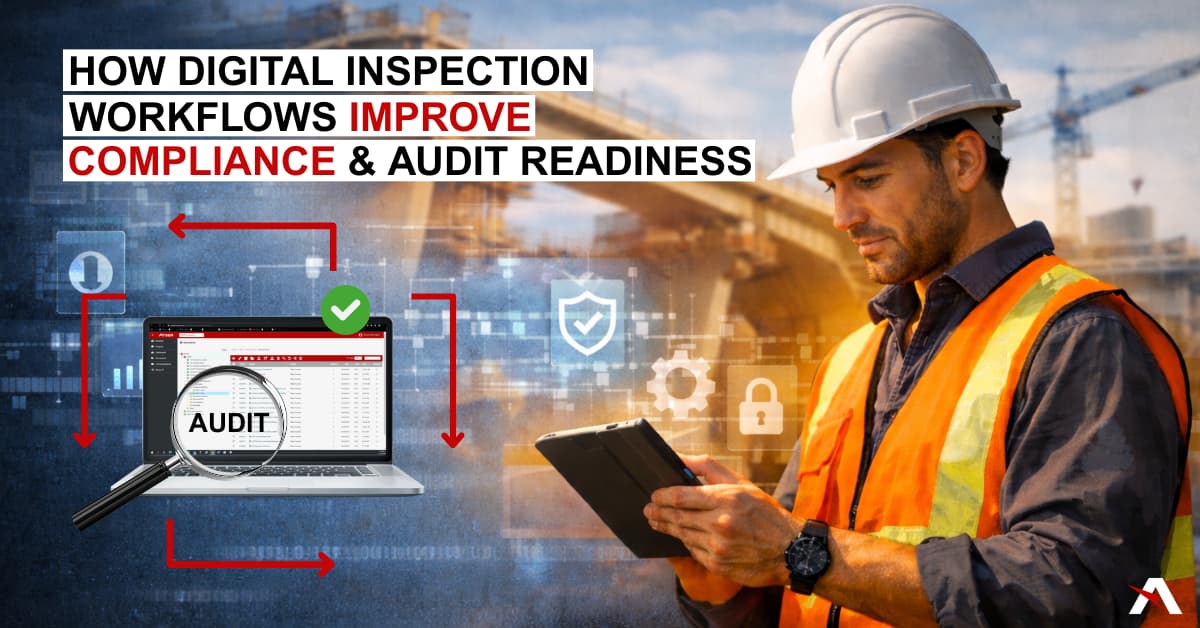
An integrated project management system supports continuous audit readiness by centralizing all project, financial, and compliance data within a single secure cloud environment. Project teams maintain a complete system of record for contracts, billing, change orders, schedules, Inspection Daily Reports (IDRs), and approvals. This ensures that documentation is accurate, traceable, and readily available for review.
Built-in workflows and structured data capture help project managers maintain consistent, up-to-date records throughout the project lifecycle. Auditors can easily review payment estimates, cost tracking, contract modifications, project schedules, key milestones, certify inspection records, and financial controls without relying on fragmented spreadsheets or disconnected systems.
Inspector Daily Reports (IDRs) play a critical role in audit support. Certified field inspectors document daily work activities, quantities, materials, and site conditions directly within the system. This data flows automatically into weekly and monthly pay estimates, creating a transparent, defensible link between field activity and financial billing. Quantities are reviewed, approved, and paid based on real-time, verifiable records.
With role-based access controls, time-stamped approvals, and full audit trails, the platform enables agencies and engineering teams to demonstrate compliance, reduce audit risk, and respond to audit requests with rapid, secure record retrieval, eliminating data gaps, manual reconciliation, and documentation errors.
The Difference ATSER Delivers
Founded in 1993, ATSER is a trusted innovator in construction technology.
Our newest software solution Manage-IT™ 2.0 delivers a fully digital, end-to-end inspection workflow powered by integrated field, project, and financial modules.
With Field-IT™, ATSER’s offline-capable mobile application, inspectors capture daily reports, inspections, checklists, quantities, photos, and material test data directly from the field. All data is time-stamped, geo-referenced, and securely synced to the central platform, eliminating manual data entry, lost paperwork, and inconsistent records.
Through the Inspector Daily Report (IDR) module, field activity is automatically structured into standardized daily logs that document work performed, materials used, site conditions, and quantities installed.
Track-IT™ requires the inspector’s certification data before allowing entries into the inspection record, enforcing standard certification requirements across all projects. Once validated, these IDRs flow directly into Track-IT™ and associated billing workflows, where quantities are reviewed, approved, and converted into weekly and monthly pay estimates.
Instead of manual reconciliation, ATSER creates a defensible financial trail that links field activity to cost tracking and approved payments, providing auditors with a clear, verifiable source of truth.
From a compliance and audit perspective, Manage-IT™ 2.0 centralizes all project documentation, including contracts, change orders, schedules, approvals, test results, and financial records, within a single secure cloud environment. With role-based access controls, time-stamped approvals, document versioning, and full audit trails, agencies can instantly retrieve accurate records for internal reviews and external audits.
For materials testing and QA/QC, Assure-IT™, our Laboratory Information Management System (LIMS) ensures that all laboratory tests, certifications, and inspection results are stored, standardized, and linked to the corresponding projects and samples, making it easy to demonstrate regulatory compliance and quality validation during audits.
The result is not just digital inspections, but built-in audit readiness by design!
ATSER replaces fragmented workflows with a unified PMIS/LIMS ecosystem that improves field productivity, strengthens compliance, reduces audit risk, and gives agencies real-time operational and financial visibility across every project.
Why Industry Leaders Choose ATSER’s PMIS
Since 1993, ATSER has delivered innovative solutions to the AEC industries. We have partnered with leading transportation agencies and public organizations nationwide, including the Texas Department of Transportation (TxDOT), Utah Department of Transportation (UDOT), New York State Department of Transportation (NYSDOT), the Harris County Toll Road Authority (HCTRA), Houston Airport System, and the Metropolitan Transit Authority of Harris County (METRO).
Built for Real-world Infrastructure Operations
Unlike generic project management tools, ATSER combines PMIS and LIMS capabilities into one integrated ecosystem. This allows organizations to manage inspections, materials testing, QA/QC, scheduling, financial tracking, and compliance within a unified platform, eliminating silos and disconnected systems.
Configurable for complex organizational needs
Industry leaders choose ATSER because it adapts to their processes, not the other way around. With configurable workflows, custom forms, user-defined approval chains, and role-based access controls, ATSER supports the operational reality of agencies, laboratories, consultants, and contractors.
Long-term Strategic Partner
ATSER is not positioned as a point solution. We are a long-term digital infrastructure partner. Organizations standardize on ATSER to modernize operations, improve governance, reduce risk, and create a foundation for data-driven decision-making across their entire project portfolio.