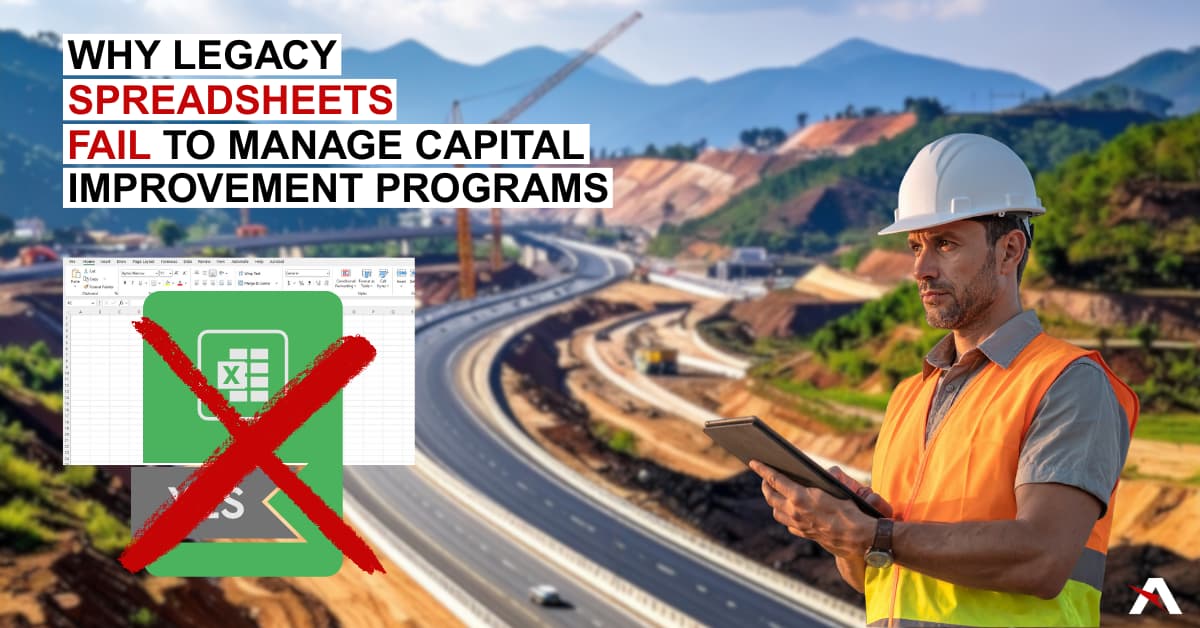
According to Saritasa, 62% of organizations still rely on outdated legacy software solutions. Reinforcing this gap, KPMG’s Global Construction Survey 2019: Future-Ready Index reports that only 34% use integrated project management systems. As a result, many companies lose Return On Investment (ROI) due to outdated spreadsheets and inefficient tools. This continued reliance further hinders performance and overall productivity across Capital Improvement Programs (CIPs).
As these programs expand in scale and complexity, companies need a software solution that provides real-time data, removes spreadsheet risks, and supports modern capital improvement program delivery.
In this blog, we will explore plausible reasons why depending on decentralized, legacy spreadsheets is a leading cause for low ROI and productivity. We will examine the challenges project teams face when using inadequate project software and how switching over to integrated project management software enhances productivity, scalability, and profitability.
The Hidden Costs of Spreadsheets
Lower Productivity
Project data grows more complex each year, especially with the introduction of Artificial Intelligence (AI) to the industry. AI is transforming the industry by optimizing design and planning for engineers and enhancing building information modeling, as AI is capable of analyzing vast amounts of data in seconds.
Statistics from the Fails Management Institute (FMI) show “roughly 2.5 quintillion bytes of data every day is produced”, and “only 8% of engineering and construction firms (E&C) have what they call real-time, full project management information systems that allow for dashboard reporting”.
Companies are constantly adding digital data to their systems, but tend not to establish an effective approach to managing and sharing their information. Factors such as increased change orders and requests for information expand a project’s data to be tracked.

Visibility Issues
When teams operate across multiple platforms, communication becomes fragmented, and as fragmentation increases, spreadsheets fail to provide real-time dashboards needed to track project progress clearly as the construction moves forward. Without reliable visibility, team members cannot assess workload distribution or identify emerging constraints.
This challenge intensifies when numerous charts crowd a single file and obscure meaningful insights. There is no easy readability, which makes insights laborious to conclude. As a result, stakeholders struggle to confirm alignment with deadlines and organizational goals. Additionally, legacy spreadsheets lack mobility, as accessing data on spreadsheets on mobile phones is challenging to view and make changes to.
Data Discrepancies from Manual Labor
Teams spend extensive hours manually entering and formatting project data. This repetitive work creates delays and increases the risk of data loss. Deleted cells or broken formulas can disrupt project tracking and eliminate essential information. Transferring data from multiple sources can also alter values and produce costly errors.
Over time, these issues accumulate and lead to significant revenue loss. Data inconsistencies may also be difficult to detect. Incorrect formulas can further distort reports and mislead decision-makers. Without clear visibility into historical edits and data ownership, organizations may face data management violations. Consequently, teams have less time for accurate analysis and informed reporting.
The Impact of a Modern PMIS
Capital Improvement Programs involve multiple projects, funding sources, stakeholders, and regulatory requirements operating simultaneously over long time periods. A modern Project Management Information System (PMIS) provides the structure, visibility, and control necessary to manage this complexity effectively. By centralizing data, standardizing processes, and enabling real-time insights, a modern PMIS allows agencies and program managers to maintain accountability, reduce risk, and make informed decisions that protect public funds and project outcomes.

Improved Accuracy
Modern PMIS platforms automate data collection and updates across schedules, budgets, contracts, and field activities. For CIPs, this means cost forecasts, progress metrics, and schedule updates reflect current conditions rather than outdated reports.
Real-time accuracy reduces reliance on manual spreadsheets, minimizes human error, and allows project teams and owners to quickly identify variances before they escalate into claims, delays, or budget overruns. Accurate, up-to-date data is essential for defensible decision-making and regulatory reporting in public infrastructure programs.
Automated systems update project information in real time and keep all stakeholders informed. With better visibility, organizations can make faster and more accurate decisions.
Standardization
Capital programs often include dozens or hundreds of projects delivered by different consultants, contractors, and departments. A modern PMIS enforces standardized workflows, reporting formats, and performance metrics across the entire program.
Integrated dashboards allow project managers to track KPIs consistently while enabling leadership to quickly compare projects, identify trends, and flag anomalies. Standardization improves governance, simplifies audits, and ensures that all projects are evaluated using the same criteria—critical for transparency and compliance in publicly funded CIPs.
Centralized Communication
CIPs require continuous coordination between owners, engineers, inspectors, contractors, and oversight agencies. A centralized PMIS creates a single source of truth where documents, RFIs, issues, action items, and decisions are tracked in one system. This improves issue resolution by allowing teams to quickly locate information, assess impacts, and implement corrective actions. Real-time updates reduce delays caused by fragmented communication, while historical records support accountability, claims avoidance, and lessons learned for future program phases.
Scalability
As capital programs grow in size and complexity, manual processes and disconnected systems become increasingly difficult to manage. A modern PMIS scales with the program, enabling real-time reporting and performance tracking across multiple projects, funding streams, and delivery methods. Advanced systems reduce administrative burden on project teams while maintaining visibility at the program level. This scalability is essential for large CIPs, where high data volumes, overlapping schedules, and long program durations demand robust systems to sustain performance, productivity, and consistent outcomes.
Capital Programs Demand More — And ATSER Delivers
Many organizations hesitate to change long-standing workflows. However, outdated tools weaken team morale and delay access to accurate information. Modern capital improvement programs require systems built for high-volume, multi-project environments.

ATSER’s Manage-IT™ Solves These Challenges
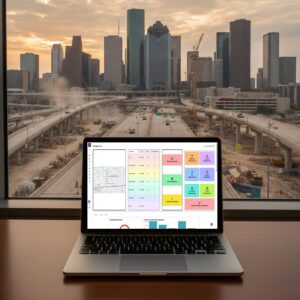
ATSER’s PMIS is built to solve these challenges. Our software solution delivers:
Real-Time Project Creation
Users can create projects using templates aligned with organizational needs. Automated milestones reduce manual work and strengthen consistency. Real-time collaboration supports faster decisions and improves multi-project management. Standardized reporting and daily updates further enhance project transparency.
User-Defined Roles Creation and Workflows
Manage-IT™ 2.0 lets users design workflows without development assistance. Roles can be customized to support organizational requirements. Project teams no longer depend on system-defined roles that limit proper system usage and operational flexibility. The platform provides a single source of truth for all project records. Its structured file system ensures consistency and preserves historical documentation. Workflows can be easily created to fit business requirements and SOPs. These workflows can trigger emails, notifications, checklists, and e-forms through defined approval paths, creating a highly efficient operational system.
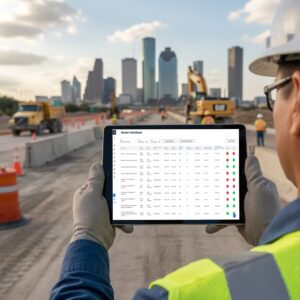
Multi-project oversight without data chaos
Quality Management dashboards provide online and offline access to standardize the reporting of quality records. These dashboards include lab control charts, mix designs, checklists, and IPPs. They also support Inspector Daily Reports that reinforce quality compliance. Together, these capabilities create a single source of truth that standardizes user functionality across all project phases and preserves critical historical data.
Conclusion: Legacy Systems Hold Capital Programs Back
Modern project environments demand tools that support efficiency and clarity. Replacing outdated spreadsheets improves productivity and strengthens ROI. Lower productivity, limited visibility, and data discrepancies remain major obstacles for teams using legacy spreadsheets. The State of data capabilities in construction 2023 Deloitte study reported that 97% of businesses gained value from better data use. The same study showed that 33% experienced significant cost reductions. Construction leaders using proper project management systems now benefit from streamlined workflows. A centralized and scalable solution can transform spreadsheets from a liability into a strategic advantage.